
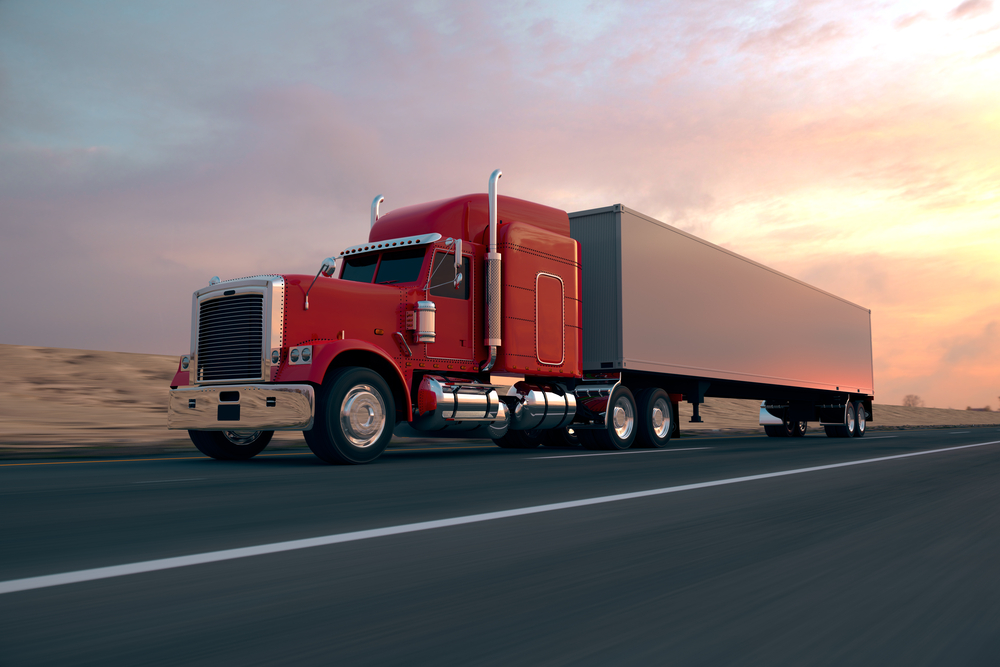
An 18-wheeler is a tractor unit coupled to a semi-trailer, and once the two are joined the combination has 18 wheels across five axles. Federal law caps that combination at 80,000 pounds gross vehicle weight, a limit set in 23 U.S.C. § 127 and mirrored in Texas.
Understanding those numbers helps explain why a crash with a semi behaves so differently from a crash between two cars, and why the weight of the truck is one of the first things our attorneys look at.
Questions about a truck crash in San Antonio? Call (210) 225-0909 for a free case review, 24/7.
Resources On This Page
- How Much Does an 18-Wheeler Weigh?
- What Are the Axle Weight Limits for a Semi-Truck?
- Why Does 80,000 Pounds Make a Crash So Much Worse?
- What Happens When a Truck Is Over the Weight Limit?
- How Does an Overweight Truck Affect an Injury Claim?
- FAQ
How Much Does an 18-Wheeler Weigh?
Between roughly 10,000 and 80,000 pounds, depending on whether it is bobtailing, pulling an empty trailer, or fully loaded. The tractor alone accounts for a large share of that before any freight is added.
| Configuration | Typical weight |
|---|---|
| Tractor alone (bobtail) | 10,000 to 25,000 lbs |
| Tractor plus empty trailer | About 35,000 lbs |
| Tractor plus loaded trailer | Up to 80,000 lbs |
| Average passenger car, for comparison | About 4,000 lbs |
Trailer type changes how much freight fits under the ceiling. Aluminum flatbeds are light, so they carry the most cargo. Dry vans weigh more, and refrigerated trailers weigh the most because insulation, a refrigeration unit, and an extra fuel tank all count against the 80,000 pounds before a single pallet is loaded.
What Are the Axle Weight Limits for a Semi-Truck?
Total weight is only half the rule. Federal and Texas law also cap how much weight can sit on any one axle or pair of axles, because concentrated loads damage pavement and bridges.
Under Texas Transportation Code § 621.101, the limits are:
- 20,000 pounds on a single axle
- 34,000 pounds on a tandem axle set
- 80,000 pounds gross, regardless of tire ratings, axle spacing, or number of axles
There is also the federal bridge formula, a calculation that limits weight based on how far apart the axles sit. Two axles spread further apart can legally carry more than two bunched together, because the load spreads across more of the bridge deck.
The Texas Department of Public Safety publishes the bridge formula tables that enforcement officers use at weigh stations.
One narrow exception exists. A truck powered primarily by natural gas or electric battery may exceed the limit by up to 2,000 pounds, capped at 82,000 pounds, to offset the added weight of the battery or fuel system.
Why Does 80,000 Pounds Make a Crash So Much Worse?
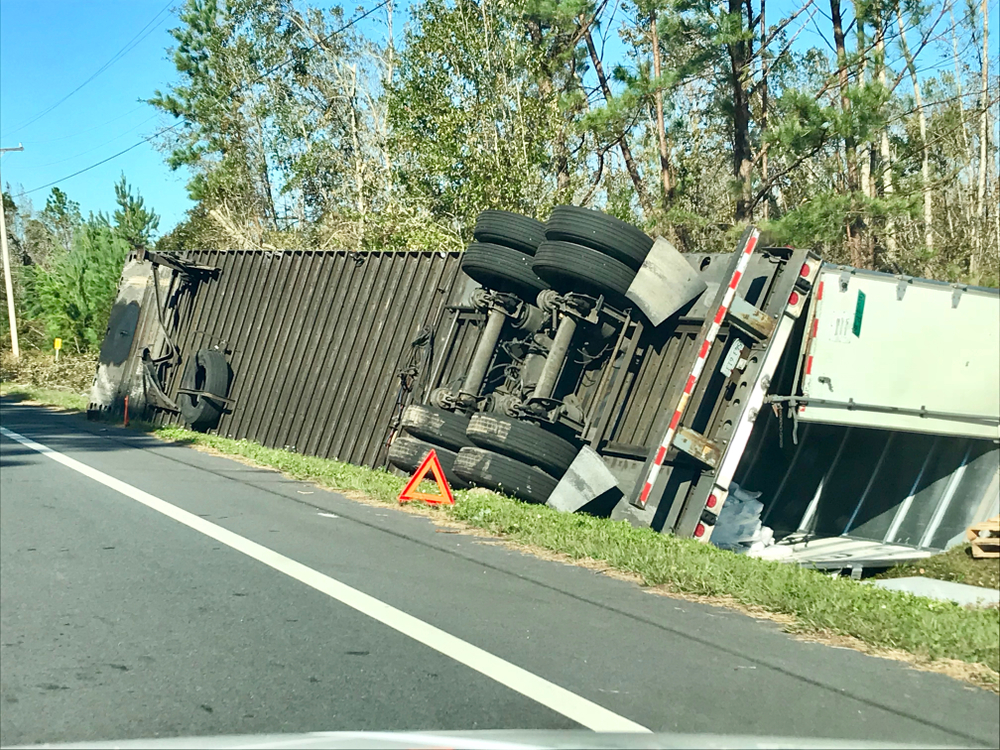
Because stopping distance and crash forces both scale with mass. A loaded tractor-trailer traveling at highway speed needs roughly 40 percent more distance to stop than a passenger car, and on wet pavement that gap widens further.
Weight also raises the center of gravity, which is why loaded semis roll over on curves and ramps that a car takes without difficulty. Interchanges like the I-10 and Loop 410 connectors in San Antonio see this regularly.
The imbalance is the whole problem. When 80,000 pounds meets 4,000 pounds, the physics of the collision are decided before either driver reacts. That is why people injured in an 18-wheeler accident tend to face far more serious injuries than the truck driver does.
What Happens When a Truck Is Over the Weight Limit?
An overweight truck faces fines, delays, and potentially an out-of-service order that stops it where it sits until the excess load is transferred. Weigh stations along I-10, I-35, and I-37 exist to catch exactly this.
Penalties in Texas scale with how far over the limit the truck is, and a load more than 5,000 pounds over the allowable weight triggers steeper consequences. Drivers can face license consequences, and carriers can be fined directly when they dispatch an overloaded truck.
Enforcement is not the same as prevention, though. Weigh stations can be closed, bypassed with a transponder, or simply avoided by routing around them, so overweight trucks reach the road every day. Improperly loaded or overweight trucks are a recurring cause of jackknifes, rollovers, and brake failures.
How Does an Overweight Truck Affect an Injury Claim?
It can shift a case substantially, because a weight violation is a documented breach of a safety rule rather than a judgment call about driving. When a truck exceeded its legal weight and that extra mass contributed to the crash, the violation becomes direct evidence of negligence.
Proving it takes records carriers are not eager to hand over: bills of lading, scale tickets, cargo manifests, dispatch instructions, and the loading company’s paperwork.
Those records also tend to point past the driver, toward whoever loaded the trailer and whoever told the driver to run it.
Weight cases frequently expand the list of responsible parties. A driver may have had no realistic way to know the trailer was 6,000 pounds over, while the shipper who loaded it and the carrier who accepted the run both did.
FAQ
How much cargo can an 18-wheeler legally carry?
Usually between 42,000 and 48,000 pounds of freight. The math is simple subtraction: the 80,000-pound ceiling minus the weight of the tractor and empty trailer, which together run about 32,000 to 38,000 pounds. Lighter aluminum flatbeds leave room for more payload, while refrigerated trailers leave the least because the cooling equipment and extra fuel count against the limit.
Can a truck legally weigh more than 80,000 pounds in Texas?
Yes, with a permit. Texas issues oversize and overweight permits through the Department of Motor Vehicles for loads that cannot be broken down, such as industrial equipment, wind turbine components, and drilling gear moving through the Eagle Ford region. Permitted loads travel under route, time, and escort restrictions.
A permit is not a free pass. A carrier that ignores its permit conditions can be held responsible when something goes wrong.
How many axles does an 18-wheeler have?
Five. One steering axle under the cab, a tandem drive axle set behind it, and a tandem axle set beneath the rear of the trailer. That arrangement gives 18 wheels total and spreads the load widely enough to satisfy the bridge formula on most routes.
Do weight limits apply to trucks that never leave Texas?
Yes. Texas applies the same 80,000-pound gross limit and the same 20,000 and 34,000 pound axle caps to intrastate carriers. A local hauler running only between San Antonio and Laredo is under the same weight rules as a carrier crossing state lines, though some federal registration and insurance requirements differ.

Talk to Someone Who Knows What the Scale Tickets Mean
Weight records, scale tickets, and loading documents have a way of disappearing while a claim is still getting organized. If a tractor-trailer hit you anywhere in Bexar County, the sooner someone demands those records, the more likely they still exist.
We answer around the clock, in English and Spanish, and there is no fee unless we recover money for you. Talk to a San Antonio truck accident lawyer at (210) 225-0909.
Meet Our Top-Rated San Antonio Truck Accident Attorneys




Attorney advertising. Weight limits, permits, and penalties are current as of writing and should be confirmed for your situation. Past results afford no assurance of similar future outcomes.