
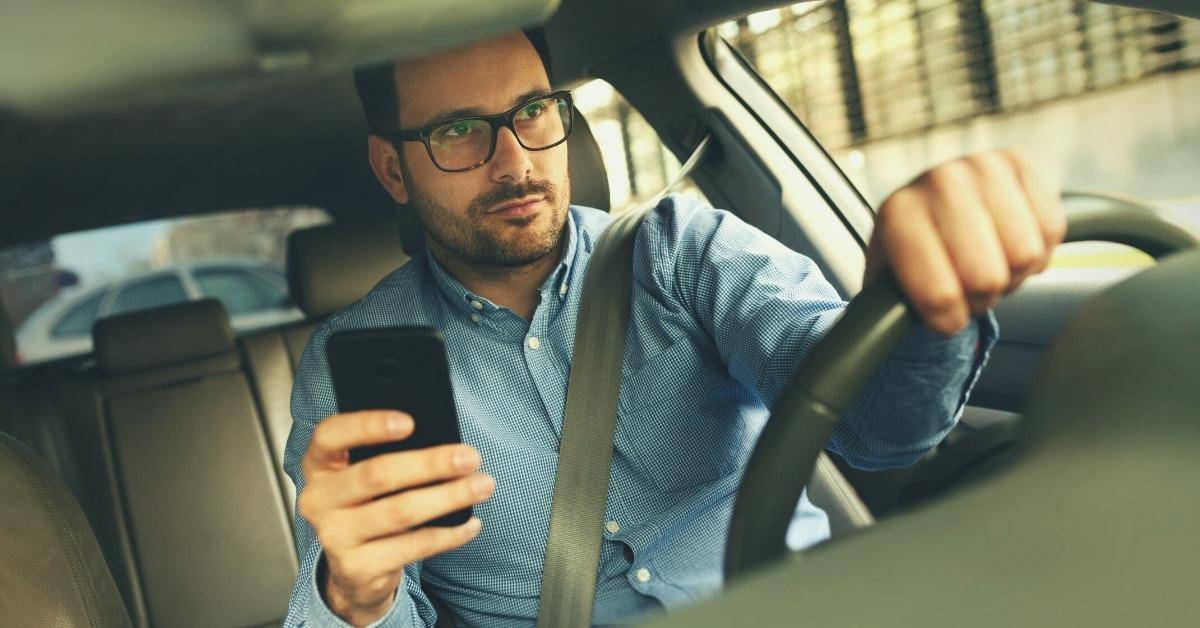
The answer hinges on a detail almost nobody thinks to preserve: what the delivery app was showing when the crash happened. That single fact can be the difference between a policy worth a few thousand dollars and one worth far more.
It is also the reason these claims get denied more often than ordinary car accident claims. Two insurers can each point at the other, and the driver’s own policy may exclude the whole thing.
Who Pays After a DoorDash or Uber Eats Driver Causes a Crash?
It depends on what the driver’s app was doing at the exact moment of impact.
- App off entirely: the driver’s personal auto insurance is the primary coverage
- App on but no order accepted: personal policies often deny, and platform coverage is limited or absent
- Order accepted and delivery underway: the platform’s liability coverage typically applies, usually with much higher limits
- Most Texas personal auto policies exclude crashes that happen while driving for pay
- Platform coverage is frequently written as excess, meaning it pays only after another policy responds
Coverage terms differ by platform and change over time, so a lawyer can help confirm what applied in your situation.
Key Takeaways About Delivery App Accident Claims
- Coverage follows the driver’s app status at the moment of impact, not their general job.
- Texas personal auto policies commonly contain an exclusion for carrying people or property for compensation, which can void coverage entirely during a delivery.
- Platform liability coverage is often excess, meaning it sits behind the personal policy rather than replacing it.
- The gap period, when a driver is logged in and waiting for an order, is where claims most often collapse.
- Texas generally allows two years to file suit, under Civil Practice and Remedies Code § 16.003.
The Three App States That Decide Coverage
Delivery platforms structure coverage around what the driver was doing, borrowing a framework Texas wrote for rideshare.
| App state | Personal auto policy | Platform coverage |
|---|---|---|
| App off, driving personally | Primary coverage applies | None |
| Logged in, waiting for an order | Often denied under the commercial use exclusion | Limited or none, varies by platform |
| Order accepted, delivery in progress | Usually excluded | Platform liability coverage typically applies, at higher limits |
The middle row is the problem. A driver circling a shopping center waiting for a ping is working, but has not accepted anything yet. The personal insurer says commercial use. The platform says no active delivery. An injured person can be left arguing with two carriers who each believe the other one owes.
Why Doesn’t the Texas Rideshare Law Cover Food Delivery?
Because the statute was written for passengers, not packages. This is the distinction that decides many of these claims, and it is widely misunderstood.
Texas Insurance Code Chapter 1954 sets minimum coverage for transportation network company drivers, requiring at least $50,000 per person, $100,000 per incident, and $25,000 in property damage while a driver is logged on and waiting for a request, with higher requirements once a prearranged ride begins.
It is the same framework that governs Lyft and Uber passenger claims. The statute defines a prearranged ride as transportation provided to a rider, beginning when the driver accepts a request and ending when the last passenger gets out. A burrito is not a rider. Food and package delivery falls outside that definition, so the statutory minimums do not squarely apply.
What fills the gap is contract, not law. Delivery platforms voluntarily mirror the same period structure in their own coverage terms, which means the protection comes from a policy the platform chose to buy and can change, rather than a floor the state sets.
What Is the Difference Between Primary and Excess Coverage?
Primary coverage pays first. Excess coverage pays only after another policy has responded and been exhausted, or in some cases only after another insurer has formally denied.
That distinction matters enormously in delivery cases. When a platform’s coverage is written as excess and the driver’s personal insurer denies the claim under a commercial use exclusion, the injured person can end up caught in a loop where nothing pays until someone forces the issue.
The problem shows up across commercial and delivery vehicle claims, not just food apps. Untangling it usually means obtaining the personal policy’s exact exclusion language, the platform’s coverage terms in effect on that date, and the driver’s app records for the relevant window. Consumers rarely get those documents by asking.
What Evidence Proves the App Was On?
The platform’s own records. Delivery apps log everything with timestamps: when the driver went online, when an order was accepted, the route, the pickup, and the drop-off.
Those records settle the coverage question, and they are held by the company with the least incentive to volunteer them. Obtaining them usually requires a formal request through a claim, which is another reason waiting works against an injured person.
The Texas Department of Insurance also publishes consumer guidance on auto coverage and the complaint process, which can be useful when a carrier’s denial does not add up.
What Claimants Often Find Helpful
Many people in this situation find it useful to ask, at the scene, whether the driver was making a delivery and for which app, and to write the answer down. Drivers usually answer honestly in the moment, and that early statement can matter later.
Photographing the vehicle can help too. Insulated delivery bags, a dash-mounted phone showing an active route, or a platform decal all support that the driver was working.
Delivery Accident Insurance Questions Answered by Attorneys
What if the delivery driver was uninsured?
Your own uninsured or underinsured motorist coverage may respond, and it is worth checking your policy even if you assume you do not have it. Texas requires insurers to offer this coverage, and many drivers carry it without realizing.
Can I file a claim against DoorDash or Uber directly?
Sometimes, though platforms generally take the position that drivers are independent contractors rather than employees. The more workable path is usually the insurance the platform maintains for these situations, which does not depend on winning that argument.
What if I was the passenger in the delivery driver’s car?
Coverage analysis works largely the same way and turns on the app state at impact. Passengers in gig drivers’ vehicles have the added option of the driver’s own coverage in some scenarios.
Does it change anything if the driver was using aor scooter?
Yes, substantially. Auto policies and platform auto coverage may not apply at all, which shifts the claim toward the driver’s personal liability, any homeowner or renter coverage, and whatever the platform provides for non-vehicle deliveries.
How do I find out what the driver’s app status was?
Through a formal claim. Platforms do not release trip records to members of the public, so the request has to come through the claims process or litigation, which is one of the practical reasons people bring a lawyer into these cases early.
Do Not Let Two Insurers Argue While Your Bills Pile Up
The frustrating part of a delivery crash is rarely the crash. It is the weeks afterward, when a personal insurer points at a platform, the platform points back, and nobody accepts responsibility for a collision that clearly was not your fault.
Our role is to pin down the app records, read both policies against each other, and make the right carrier answer. Consultations are free, we work in English and Spanish, and there is no fee unless we recover money for you.
Reach our San Antonio rideshare and delivery accident attorneys at (210) 225-0909, any hour of the day.
Attorney advertising. General information, not legal advice about your situation. Platform coverage terms change, so confirm what applied on the date of your crash. Past results afford no assurance of similar future outcomes.