
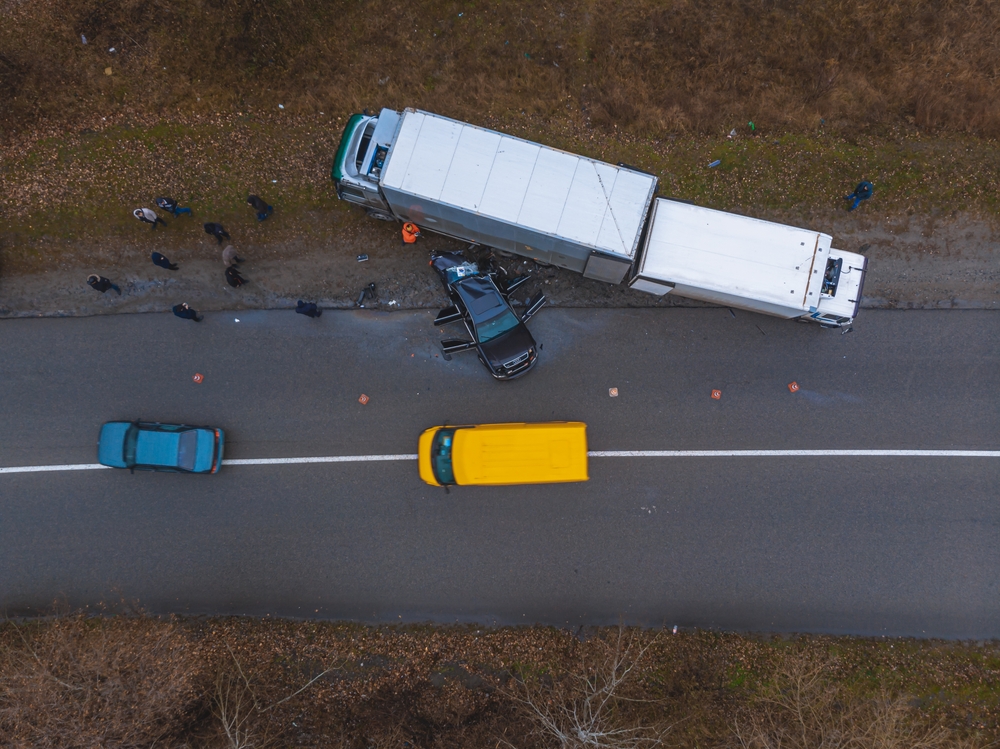
An underride crash is not a bad rear-end collision. It is a different event, and it needs a lawyer who treats it that way.
When a car slides beneath a trailer, the bumper, crumple zone, and airbags never engage, because the part of the car designed to absorb impact passes under the trailer untouched. The trailer’s steel frame reaches the windshield instead.
That is why our underride accident lawyers investigate the trailer’s rear impact guard as closely as we investigate the driver, and why these cases often produce a claim against the trailer manufacturer that no one else spotted.
Our founder, George Salinas, is a member of the American Board of Trial Advocates, which requires at least 10 completed jury trials plus a vote by plaintiff attorneys, defense attorneys, and judges. The firm has recovered more than $100 million for injured Texans. We handle underride cases throughout San Antonio, Austin, and the I-35 and I-10 freight corridors between them.
Call (210) 225-0909 for a free case review. Someone answers 24/7, in English and Spanish.
Resources On This Page
- What Is an Underride Accident?
- Why Do Underride Crashes Cause Such Severe Injuries?
- Was the Trailer’s Underride Guard Supposed to Stop This?
- What About Side Underride Crashes?
- Why Hire Our Underride Accident Lawyers?
- What to Expect After You Call
- How Long Do You Have to File an Underride Claim in Texas?
- FAQ for Underride Accident Lawyer
What Is an Underride Accident?
An underride accident happens when a smaller vehicle slides underneath a large truck or trailer during a collision. The passenger compartment takes the impact directly, because the car’s own safety structure passes beneath the trailer without ever making contact.
Federal regulators describe the mechanism plainly. In NHTSA’s rulemaking on rear impact protection, an underride crash occurs when the front end of a passenger vehicle slides under the rear of a larger vehicle. Injuries in these crashes concentrate in the head, neck, and upper body, and they occur at speeds that would be survivable in almost any other type of collision.
There are three patterns:
- Rear underride, where a car strikes the back of a trailer. This is the most common and the most regulated.
- Side underride, where a car strikes the side of a trailer, often when a truck is turning across traffic or backing across a road. No federal guard requirement covers this.
- Front underride, where a truck strikes a smaller vehicle and rides over it.
Knowing which pattern applies changes the entire investigation, because the equipment rules and the available claims differ for each.
If you are still sorting out what type of crash you were in, our San Antonio truck accident lawyers can often tell from the photographs.
Why Do Underride Crashes Cause Such Severe Injuries?
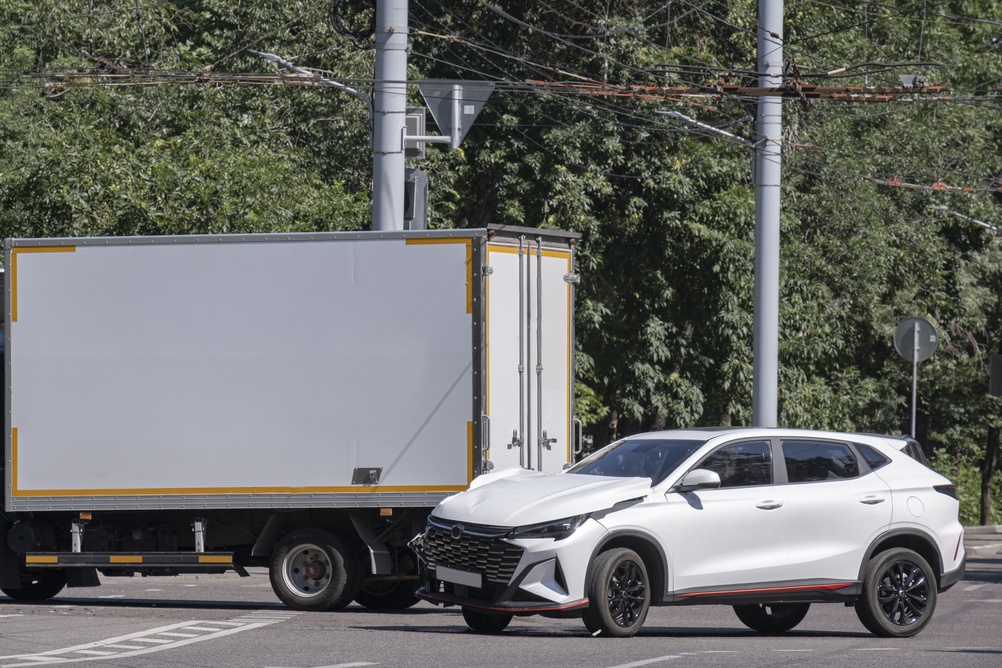
Because every safety system in a modern car assumes the car will hit something at bumper height. Underride removes that assumption.
Crumple zones absorb energy by collapsing. Airbags deploy based on sensors reading a frontal impact. Seat belts restrain a body against forces coming from the front. In an underride collision, the trailer bed passes above the bumper line and none of that engineering does its job. The occupants absorb what the vehicle was built to absorb.
That is also why underride cases involve catastrophic injury or death far more often than their crash speed would suggest. A collision at 35 miles per hour that a car would normally handle can be fatal when the trailer edge enters the passenger compartment, in part because fully loaded 18-wheelers can weigh up to 80,000 pounds and simply do not move on impact.
If a family member was killed or seriously hurt in a crash with a trailer, call (210) 225-0909. We will review it at no cost.
Was the Trailer’s Underride Guard Supposed to Stop This?
In a rear underride crash, usually yes. Federal Motor Vehicle Safety Standards No. 223 and No. 224 require most new trailers and semi-trailers rated at 10,000 pounds or more to carry a rear impact guard, a steel bar mounted low and wide across the back of the trailer designed to catch a striking car before it slides under.
NHTSA upgraded both standards in a June 2022 final rule, raising the performance threshold so guards must prevent passenger compartment intrusion when a car strikes at 35 miles per hour, up from the previous 30 mile per hour design point. The requirement took effect for new trailers with a compliance date in July 2024.
Standards on paper and performance on the road are two different things, and that gap is where these cases live. A guard can fail because it was corroded, previously damaged and never repaired, modified by the carrier, mounted incorrectly, or simply designed to bend at the edges rather than hold. Offset impacts, where a car strikes only part of the trailer’s width, have historically been the weak point.
Our investigation looks at the guard itself:
- Whether the trailer was required to have a compliant guard, based on its build date and weight rating
- Whether the guard was present, intact, and properly mounted at the time of impact
- Whether the carrier’s inspection records show prior damage that was noted and ignored
- Whether the guard deformed in a way inconsistent with its certified strength
- Whether reflective conspicuity tape was present and visible, which affects whether the driver could see the trailer at all
When a guard failed to do what the standard required, the claim extended past the driver and the carrier to the trailer manufacturer.
What About Side Underride Crashes?

There is no federal requirement for side underride guards, and that absence is often the center of the case. A trailer sitting across a dark road while a truck completes a turn presents nothing to a driver but a gap between the wheels.
Congress directed NHTSA to research side guards and convene a federal advisory committee on underride protection through the Bipartisan Infrastructure Law, and the agency published a report to Congress on the subject, but no side guard rule is in force.
That does not leave an injured family without a claim. Side underride cases typically turn on the driver’s decision to block a travel lane, the carrier’s routing and training, whether the trailer’s reflective tape met federal conspicuity requirements, and whether the maneuver should have been done with a spotter or at a different time of day.
Truck traffic through Bexar County runs heavily at night on I-35 and Loop 1604, and side underride cases here frequently involve a trailer crossing an unlit road.
Why Hire Our Underride Accident Lawyers?
Because most firms handle an underride crash as a rear-end case, and a rear-end case does not reach the trailer manufacturer.
We Treat the Trailer as Evidence, Not Debris
Trailers get repaired, repainted, sold, or scrapped. Once that happens, the physical proof of a guard failure is gone permanently and no engineer can reconstruct it from photographs. Our first move is a preservation demand covering the trailer itself, the guard, the maintenance and inspection file, and the manufacturer’s certification records.
We also pull the carrier’s federal safety history and the annual inspection records that should have flagged a damaged guard. Carriers rarely volunteer that a guard was noted as bent months before the crash.
A Trial Record the Other Side Can Check

George Salinas has practiced for roughly two decades and began his career at an insurance defense firm before moving to plaintiff work. Several of our attorneys share that background, which is how we know that product defect claims get taken seriously only when the other side believes the case will reach a jury.
The firm brings more than 110 years of combined experience and has obtained results including $7 million and $6 million in tractor-trailer collisions. Past results afford no assurance of similar future outcomes.
We have also handled the version of this case no family should face. In one matter, we represented a widow and her young children after a wheel separated from an 18-wheeler, crossed the median, and came through her husband’s windshield while he drove to a job interview.
Call (210) 225-0909. There is no cost to find out whether the guard failed.
What to Expect After You Call
The first conversation is free and commits you to nothing. If we take the case, here is how it moves.
- Preservation. We demand that the trailer, the guard, and all inspection records be held and not repaired, sold, or destroyed.
- Physical inspection. Engineers examine the guard for corrosion, prior damage, weld failure, and deformation patterns, and compare it against the standard it was certified to meet.
- Records and reconstruction. We pull driver logs, the engine control module data, the carrier’s safety record, and the trailer’s manufacturing and certification history, then reconstruct the impact.
- Building every available claim. Negligence against the driver and carrier, and product liability against the trailer or guard manufacturer where the evidence supports it.
- Suit and resolution. We file in the appropriate Bexar County district court and prepare the case for trial. Most resolve before that point, but only when the file is genuinely ready.
Throughout, you hear from an attorney directly. George still gives clients his cell number.
How Long Do You Have to File an Underride Claim in Texas?
Generally two years from the date of the crash, or from the date of death in a wrongful death claim, under Texas Civil Practice and Remedies Code § 16.003.
Product liability claims carry an additional wrinkle. Texas applies a statute of repose under § 16.012 that can bar a claim against a manufacturer a set number of years after the product was first sold, regardless of when the injury happened. On an older trailer, that clock may matter more than the two-year deadline.
Shared fault comes up constantly in underride cases, since insurers argue the car was following too closely. Texas allows recovery as long as your share of responsibility is not greater than 50 percent, with the award reduced accordingly.
FAQ for Underride Accident Lawyer
How do I know whether my crash was an underride accident?
The vehicle damage usually answers it. Underride crashes leave the roof, windshield pillars, or upper doors crushed while the bumper and lower front end stay comparatively intact, which is the opposite of a normal collision. Airbags often do not deploy at all. If the photographs show damage concentrated above the hood line, the case should be investigated as an underride.
Can I sue the trailer manufacturer instead of the trucking company?
You can often pursue both, since they are separate claims with separate insurance. The claim against the carrier is about how the truck was driven and maintained. The claim against the manufacturer is about whether the guard was defectively designed or built, and pursuing both is common where a guard failed at a speed it was certified to withstand. Our page on 18-wheeler accident claims covers the carrier side.
What if the trailer was already repaired before I hired a lawyer?
The case is harder but not necessarily over. Repair invoices, insurance photographs, the body shop’s records, and the carrier’s post-crash inspection can sometimes reconstruct the guard’s condition. Reaching us before the trailer is repaired gives a far stronger position, which is the practical reason we ask people to call early.
Are underride guards required on box trucks and delivery trailers?
The rear impact guard requirement generally reaches trailers and semi-trailers with a gross vehicle weight rating of 10,000 pounds or more, though certain vehicle types are excluded. Whether a specific truck was covered depends on its configuration and build date, and it is one of the first things we verify.
Does it matter that the truck was stopped when I hit it?
It can help your case rather than hurt it. A trailer parked on a shoulder, stalled in a lane, or stopped across a road raises questions about warning devices, hazard lighting, reflective tape, and whether the driver followed federal rules for a disabled vehicle. A stationary trailer is one of the more common underride scenarios and rarely means the other driver was blameless.
Meet Our Top-Rated San Antonio Truck Accident Attorneys




Before the Trailer Gets Repaired, Make One Call
Trailers go back into service quickly. The guard that failed can be replaced within days, and once it is, the strongest part of the case leaves with it.
You do not need to know whether you have a product claim, a negligence claim, or both. That is our job to figure out, at no cost to you and no fee unless we recover money.
Reach us any hour at (210) 225-0909, in English or Spanish.
Attorney advertising. Federal safety standards and Texas deadlines referenced here are current as of writing and should be confirmed for your situation. Past results afford no assurance of similar future outcomes.