
A crush injury happens when part of the body is compressed between two forces, and the damage is rarely limited to what you can see. The Centers for Disease Control and Prevention defines it as compression that causes muscle swelling or neurological disturbance, and it separates that from crush syndrome, which is the whole-body reaction that can follow.
That distinction is the single most important thing on this page. A person pinned under a load can be alert and talking at the scene and become critically ill after they are freed, because the crushed muscle releases toxins into the bloodstream the moment circulation returns.
Hurt in a crush accident in Texas? George Salinas Injury Lawyers reviews these cases at no cost (210) 225-0909
Resources On This Page
- What Causes a Crush Injury?
- Why Are Trench Collapses So Often Fatal?
- What Is Crush Syndrome?
- What Is Compartment Syndrome and Why Is It an Emergency?
- What Are the Long-Term Effects of a Crush Injury?
- Who Can Be Held Responsible for a Crush Injury in Texas?
- What Compensation Is Available for a Crush Injury?
- How Long Do You Have to File a Crush Injury Claim?
- Crush Injury Questions, Answered
- The Injury Is Not Over When You Leave the Hospital
What Causes a Crush Injury?
Weight, machinery, and vehicles, usually at work. The mechanism is compression, not impact, which is how it differs from being struck by something.
Common causes:
- Equipment rollover and heavy machinery tip-overs
- Trench and excavation collapses
- Loads falling from forklifts, cranes, or racking
- Being pinned between a vehicle and a fixed object
- Unguarded machinery, rollers, presses, and augers
- Vehicle crashes where the passenger compartment collapses
- Structural collapses on construction sites
OSHA groups these under the “caught-in or caught-between” category, one of its Focus Four construction hazards, and defines it as injuries from being squeezed, caught, crushed, pinched, or compressed between two or more objects. Impact alone is a struck-by injury. Compression is a caught-in injury.
The numbers are not small. The Bureau of Labor Statistics recorded 5,070 fatal work injuries in 2024, with 1,032 of them in construction and extraction occupations, and 213 deaths from being struck, caught, or compressed by running powered equipment.
Why Are Trench Collapses So Often Fatal?
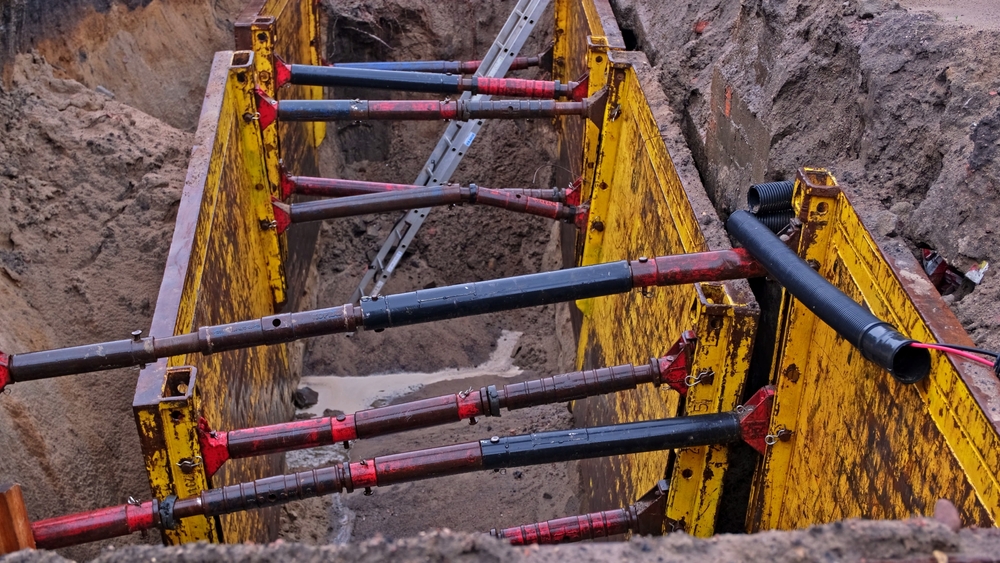
Because soil is far heavier than people expect and there is no time to react. OSHA puts it directly: one cubic yard of soil can weigh nearly 3,000 pounds, roughly the weight of a car, and workers can suffer death or serious injury within minutes of a cave-in.
Trenching kills an average of 40 workers a year in the United States. Federal excavation standards under 29 CFR 1926.652 require a protective system for excavations five feet deep or more unless the cut is entirely in stable rock, and require a designated competent person with authority to stop work and correct hazards.
When a trench collapses, the question is almost never whether a rule existed. It is who was responsible for following it.
What Is Crush Syndrome?

Crush syndrome is what happens to the rest of the body after a limb or torso has been compressed. Damaged muscle breaks down and releases myoglobin, potassium, and other cell contents into the bloodstream, a process called traumatic rhabdomyolysis.
Two things follow, and both can kill.
Kidney failure. Myoglobin deposits in the kidney tubules and causes damage. Roughly 50% of people who develop crush syndrome develop acute kidney failure, and delays past 12 hours raise that risk. Once kidney injury develops in a rhabdomyolysis patient, published mortality runs between 30% and 50%.
Cardiac arrhythmia. Potassium released from oxygen-starved muscle causes hyperkalemia, which can produce life-threatening heart rhythm disturbances, including cardiac arrest.
There is no fixed amount of compression time that triggers it. CDC guidance notes crush syndrome occurring after less than an hour of compression, and recommends intravenous fluids before release in prolonged entrapments. What is consistent is that the danger peaks when the person is freed, not while they are trapped.
Talk with an attorney about a serious crush case before the site is cleaned up. Call (210) 225-0909.
What Is Compartment Syndrome and Why Is It an Emergency?
Compartment syndrome is pressure building inside a closed muscle compartment until it cuts off the blood supply. Muscles are wrapped in tough sheets of tissue that do not stretch. When a crushed limb swells inside that wrapping, the pressure has nowhere to go, and the muscle and nerves inside begin to die.
Normal compartment pressure runs from 0 to 8 mmHg. Above about 30 mmHg is considered diagnostic. The treatment is a fasciotomy, a surgical procedure that opens the fascia with long incisions to release the pressure.
The timing data is stark, and it is the reason a delayed diagnosis case is worth taking seriously:
| Time from injury to fasciotomy | Chance of normal limb function |
|---|---|
| Within 6 hours | Nearly complete recovery |
| 6 to 12 hours | About two thirds |
| More than 12 hours | About 8% |
| Beyond 36 hours | Surgery may no longer help |
One published series found that fasciotomy delayed to 12 hours produced a 46% infection rate and a 21% amputation rate.
Warning signs are sometimes described as the “Ps”: pain out of proportion to the injury, pressure, pallor, paresthesia meaning numbness or tingling, paralysis, and pulselessness. Pain that keeps escalating despite medication, and pain when someone gently stretches the limb, are the earliest and most reliable signals. Most of the other signs appear late, which is exactly the problem.
What Are the Long-Term Effects of a Crush Injury?
They frequently outlast the hospital stay by decades. The injury is to muscle, nerve, bone, and blood supply at once, and nerve tissue is the slowest to recover.
- Amputation, in cases where circulation was lost too long
- Volkmann’s contracture, a permanent muscle contraction that leaves a hand or limb clawed and unusable
- Permanent nerve damage. Compression injuries can cause total loss of motor and sensory function even where the nerve was never cut
- Chronic pain, numbness, and cold intolerance
- Chronic kidney disease, in patients who survived acute kidney failure
- Loss of grip strength or weight-bearing capacity, which ends careers in trades
Nerve recovery is measured in millimeters. Damaged axons regrow at roughly 1 mm per day, which works out to about an inch a month. An arm nerve injury can take a year or more to regain function, if it regains it at all.
That timeline is central to valuing a case, because someone’s earning capacity may not be known until a year or more after the accident.
Crush injuries to the torso can also involve spinal cord damage and paralysis, which is its own category of catastrophic claim.
Who Can Be Held Responsible for a Crush Injury in Texas?

Frequently more than one party, and in Texas that includes the possibility of suing the employer directly.
The employer, if it does not carry workers’ compensation. Texas is the only state where private employers may opt out of the workers’ compensation system. Those employers are called nonsubscribers, and under Texas Labor Code Section 406.033 a nonsubscriber sued by an injured employee cannot use the common law defenses of contributory negligence, assumption of the risk, or the fellow servant rule. That is a significantly stronger position than a workers’ compensation claim.
A third party, when the employer does carry coverage. Workers’ compensation generally bars suing a subscribing employer, but it does not bar claims against anyone else:
- A general contractor or another subcontractor sharing control of the site
- The owner or operator of the equipment involved
- A machinery manufacturer, where a guard was missing or a design was defective
- A property owner who created or ignored the hazard
- A maintenance company that serviced the equipment
Third-party claims frequently recover far more than workers’ compensation benefits, because compensation pays medical and a portion of wages but nothing for pain, impairment, or disfigurement.
We handle workplace crush injuries and construction site accidents on both tracks, and the two often run at the same time.
What Compensation Is Available for a Crush Injury?
Everything the injury actually costs, when it is documented well enough to prove.
Economic damages cover emergency care, surgeries including fasciotomy and reconstruction, dialysis, prosthetics, home and vehicle modification, attendant care, projected future medical treatment, lost wages, and lost earning capacity.
Non-economic damages cover physical pain, mental anguish, physical impairment, and disfigurement, past and future. In amputation and permanent-function cases these are typically the largest component.
Exemplary damages may be available where the conduct crossed into gross negligence, such as a known unguarded machine or an excavation dug without shoring. Texas Civil Practice and Remedies Code Section 41.008 caps them at the greater of $200,000 or twice economic damages plus non-economic damages up to $750,000.
In catastrophic cases, a certified life care planner projects decades of costs and an economist reduces that to present value. That projection is often many times the size of the medical bills already incurred, and it is the number early settlement offers ignore.
How Long Do You Have to File a Crush Injury Claim?
Two years from the date of injury for most Texas personal injury suits, under Texas Civil Practice and Remedies Code Section 16.003, and two years from the date of death in a wrongful death claim.
Workers’ compensation has its own, shorter reporting deadlines, and claims against a governmental entity generally require written notice within six months.
The evidence runs out faster than any of those clocks. Equipment is repaired or returned to service, sites are cleaned, and internal incident reports are written before anyone consults a lawyer.
Crush Injury Questions, Answered
I was released from the hospital and then got much sicker. Is that connected?
It can be. Kidney injury and compartment syndrome frequently develop hours to days after the compression is relieved. Dark or reduced urine, escalating limb pain, numbness, or weakness after discharge are reasons to return for evaluation right away.
Can I sue if I already accepted workers’ compensation benefits?
Often yes, against a third party. Accepting benefits does not extinguish a claim against an equipment manufacturer, a contractor, or a property owner. The compensation carrier may assert a lien on the recovery, and negotiating that lien down is part of the work.
Does an OSHA citation mean I win my case?
No, but it helps considerably. A citation is evidence that a safety standard existed and was violated. Your civil claim still requires proof that the violation caused your injury and the extent of your damages.
What if my hand looks fine but does not work the way it did?
That is a compensable injury. Loss of grip, sensation, and fine motor control after a crush is common, frequently permanent, and consistently undervalued by insurers because there is nothing visible to photograph.
Who pays for the future surgeries I have not had yet?
That is what future medical damages are for. Proving them takes treating physician testimony and, in serious cases, a life care plan. Settling before those projections exist is the most common way a crush case gets underpaid.
Meet Our Top-Rated San Antonio Injury Attorneys




The Injury Is Not Over When You Leave the Hospital
Crush injuries have a second and third act: the kidney complications, the surgeries nobody mentioned at discharge, the year of waiting to find out whether a nerve comes back. Insurance offers made in month one are built on none of that.
George Salinas began his career representing insurance companies before he began suing them, so he understands how a catastrophic claim gets valued and where the discounting happens. He is a member of the American Board of Trial Advocates, a group that requires attorneys to have actually tried cases to juries, and he builds every serious file for a courtroom.
Reach George Salinas Injury Lawyers at (210) 225-0909 or in Austin at (512) 851-1004. The review costs nothing and there is no fee unless we win.