
Almost any firm in town will sign an 18-wheeler case. Fewer have actually tried one to a Bexar County jury, and the trucking company’s insurer knows exactly which is which.
Our founder, George Salinas, is a member of the American Board of Trial Advocates, a group you cannot buy your way into: it takes at least 10 completed jury trials, a nomination, and a vote by plaintiff attorneys, defense attorneys, and judges. That record is the reason hiring the right 18-wheeler accident lawyer changes what a carrier is willing to pay.
We have recovered more than $100 million for injured Texans, including $7 million and $6 million results in tractor-trailer collisions. Our San Antonio 18-wheeler accident lawyers handle these cases across Bexar County and the I-10 and I-35 freight corridors, and we work alongside our San Antonio truck accident lawyers on every commercial vehicle claim the firm takes.
Call +1 (210) 225-0909 for a free case review. We answer 24/7, in English and Spanish.
Resources On This Page
- What Does an 18-Wheeler Accident Lawyer Actually Do for Your Case?
- Why Does 18-Wheeler Crash Evidence Disappear So Fast?
- The Insurance Layers Behind a Single Tractor-Trailer
- Why Hire Our San Antonio 18-Wheeler Accident Lawyers?
- What to Expect After Your First Call
- How Long Do You Have to File an 18-Wheeler Claim in Texas?
- FAQ for 18-Wheeler Accident Lawyer
- Talk to a Trial Lawyer Before the Carrier’s Clock Runs Out
What Does an 18-Wheeler Accident Lawyer Actually Do for Your Case?
An 18-wheeler accident lawyer builds a claim against the trucking company, its insurers, and the driver after a semi-truck crash. In Texas, that work runs on federal trucking rules, multiple liable businesses, and insurance towers that often start above $1 million. It is a different job from a car accident claim, not a bigger version of one.
A two-car collision usually involves one driver, one policy, and a police report. A tractor-trailer case involves a motor carrier, possibly a separate trailer owner, a broker, a shipper, a maintenance contractor, and a driver who may be an employee or an independent contractor. Each one carries separate coverage and separate records.
Those records are the case. Federal Motor Carrier Safety Administration rules, known as FMCSA rules, require carriers to document driver hours, vehicle inspections, and hiring decisions. When we can show the carrier broke its own federal obligations, the claim stops being about one bad moment on the highway and becomes about a company that let it happen.
Why Does 18-Wheeler Crash Evidence Disappear So Fast?
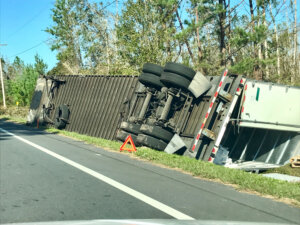
Because federal law only requires trucking companies to keep the most important records for six months. Under 49 CFR § 395.8(k), a carrier must retain drivers’ records of duty status, the daily logs showing hours behind the wheel, for six months and no longer. Electronic logging device data, dashcam footage, and engine control module readings can be overwritten far sooner than that.
Meanwhile, the carrier is moving fast in the other direction. Major trucking insurers keep rapid-response teams on call, and investigators and defense counsel are often at the scene the same day photographing skid marks and interviewing witnesses before anyone has spoken to you.
Our first move is a spoliation letter, a formal legal demand that the carrier preserve evidence and stop routine deletion. Sent early, it locks down:
- Electronic logging device records showing whether the driver exceeded the 11-hour driving limit and 14-hour on-duty window set by federal hours-of-service rules
- Engine control module data, the truck’s black box, which captures speed, braking, and throttle in the seconds before impact
- The driver qualification file, including prior violations, drug and alcohol testing, and training records
- Maintenance and inspection logs, which matter because fully loaded 18-wheelers can weigh up to 80,000 pounds and brake failures at that weight are rarely survivable
- Dispatch records, bills of lading, and cargo loading documents
Every week that passes makes that list shorter. If a semi-truck hit you on I-10, I-35, Loop 1604, or anywhere in Bexar County, the timing of your first call matters more than most people realize.
Call +1 (210) 225-0909 now and we will send the preservation letter today.
The Insurance Layers Behind a Single Tractor-Trailer
One 18-wheeler crash can involve several policies at once, which is why these claims are worth more than car accident claims and why carriers fight them harder. Federal law sets the floor. FMCSA financial responsibility rules under 49 CFR Part 387 require most interstate carriers hauling general freight to keep at least $750,000 in liability coverage, rising to $5 million for certain hazardous materials.
That federal minimum is only the beginning. Most real cases look more like this:
| Coverage layer | Who carries it | Why it matters to your claim |
|---|---|---|
| Primary liability | The motor carrier | The first money available, often $1 million on brokered freight |
| Excess or umbrella | The motor carrier or its parent company | Frequently adds $5 million to $25 million on large fleets, and is usually invisible until suit is filed |
| Trailer or equipment owner | A separate leasing company | Applies when the tractor and trailer belong to different businesses |
| Broker or shipper coverage | The company that arranged or loaded the freight | Comes into play on negligent selection or improper loading claims |
| Your own UM/UIM | You | Uninsured and underinsured motorist coverage, which can fill gaps when the carrier’s limits fall short |
Finding the layers above the primary policy takes discovery, depositions, and a willingness to file suit. Firms that plan to settle quickly rarely look for them. If you want a sense of the range these cases fall into, we break down what an 18-wheeler settlement is worth on a separate page.
Why Hire Our San Antonio 18-Wheeler Accident Lawyers?
Because the number a carrier offers depends less on your injuries than on who is holding your file. Insurance companies keep historical records of how individual firms handle cases, and they price offers accordingly. Our results in tractor-trailer litigation are part of that record.


A Trial Record the Other Side Can Verify
George Salinas has practiced law for roughly two decades and sits on the state bar grievance committee. His ABOTA membership signals something concrete to defense counsel: this is a lawyer who has stood in front of juries and will do it again. The firm brings more than 110 years of combined experience to commercial vehicle work.
In one case, we represented a widow and her young children after a wheel separated from an 18-wheeler, crossed the center median, and struck her husband’s windshield while he was driving to a job interview. We resolved the claim against the primary responsible party and continue pursuing a remaining defendant. Prior results depend on the facts of each case and do not predict any particular outcome.
Attorneys Who Started on the Insurance Side
George began his career at an insurance defense firm before moving to plaintiff work, and several of our attorneys share that background. That is not a marketing line. It means we know how adjusters use the gap-in-treatment argument, how they pull your prior claims history within days, and how delay itself is a strategy, because the longer a carrier holds the money, the more it earns on the float.
You also get direct access. George still gives clients his cell number, something his colleagues find unusual after 20 years. We are available around the clock, and our staff works in both English and Spanish.
Ready to talk it through? Call +1 (210) 225-0909.
What to Expect After Your First Call
The consultation is free, and nothing about it commits you to anything. Here is how an 18-wheeler case moves through our office once you hire us.
- Preservation and investigation. We send the spoliation letter, pull the carrier’s federal safety record, and put reconstruction engineers on the scene while physical evidence still exists.
- Medical coordination. Many providers turn away accident claimants to avoid insurance subpoenas. We connect you with physicians who will treat you and, when needed, explain in court how the crash caused your injuries.
- Building the damage model. Lost earning capacity, future care needs, and the non-economic harm all have to be documented and supported by qualified professionals, not just asserted.
- Suit and discovery. We file in the appropriate Bexar County district court, take depositions of the driver and the carrier’s safety director, and press for the excess policies.
- Resolution. Most cases settle, often once the carrier sees the file is genuinely trial-ready. If the offer is not fair, we try it.
Throughout, you hear from an attorney, not only a case manager. We will tell you what you need to hear about your case rather than what sounds good.
How Long Do You Have to File an 18-Wheeler Claim in Texas?
Two years from the date of the crash, in most cases. Texas Civil Practice and Remedies Code § 16.003 gives injured people two years to file a personal injury lawsuit, and the same two-year window applies to a wrongful death claim, running from the date of death.
Two years sounds generous until you remember that the carrier’s logs may be gone in six months. Waiting does not preserve your options, it quietly removes them.
Shared fault is a separate question that carriers raise constantly in truck cases. Texas follows proportionate responsibility under § 33.001: you can still recover as long as your share of the blame is not greater than 50 percent, though your award is reduced by your percentage.
Being blamed by an adjuster is not the same as being barred from recovery, and that argument is often the first thing a good investigation dismantles.
FAQ for 18-Wheeler Accident Lawyer
How much does an 18-wheeler accident lawyer cost in San Antonio?
Nothing upfront. We work on contingency, meaning our fee is a percentage of what we recover and you owe us no attorney’s fee if we recover nothing. The firm advances case expenses too. That matters in trucking litigation, where reconstruction engineers, testifying physicians, and depositions can run into the tens of thousands of dollars.
That cost is a real reason some firms push for a quick settlement instead of building the case.
How do I find out which trucking company owned the truck that hit me?
Every interstate commercial truck displays a USDOT number on the cab, and the police report usually records it. That number lets us pull the carrier’s profile through the FMCSA’s company snapshot database, which shows the registered business, its safety rating, its crash history, and the insurance filings on record.
If you did not catch the number and the report is incomplete, we can often trace ownership through the trailer, the cargo documents, or the responding agency’s records.
Can I still hire a lawyer if the trucking company’s insurer already offered me money?
Usually yes, as long as you have not signed a release. Carriers often make a modest offer within days, before anyone knows how serious the injuries will turn out to be, and that check comes attached to paperwork closing your claim permanently.
Once signed, there is rarely a way to undo it. If you have received an offer or been asked to sign anything, let us read it before you respond.
What if the trucking company is based outside of Texas?
That rarely changes anything. A carrier that sends trucks through Texas can generally be sued here for a crash that happened here, and an 18-wheeler collision in San Antonio is typically filed in Bexar County. Out-of-state carriers are also required to designate an agent in each state to accept legal papers, so serving a company headquartered in Illinois or Arkansas is routine for us.
Does my immigration status affect my 18-wheeler accident claim?
No. Texas tort law protects anyone injured by another’s negligence, regardless of citizenship or immigration status, and a carrier cannot use your status as a defense to what it did.
We understand why people hesitate to come forward right now, and we handle these cases with that concern in mind, including how and where we communicate with you. San Antonio has a large immigrant community, and those families have the same right to answers as anyone else.
Meet Our Top-Rated San Antonio Truck Accident Attorneys




Talk to a Trial Lawyer Before the Carrier’s Clock Runs Out
There is no charge to find out where you stand, and no fee unless we recover money for you. If your injuries keep you from coming to us, we will come to you, at the hospital, at home, or wherever you are recovering.
You can reach a person at our office at any hour, in English or Spanish, and immigration status has no bearing on your right to bring a claim in Texas.
Call +1 (210) 225-0909 or send us a message to start your free case review.
Attorney advertising. Past results afford no assurance of similar future outcomes, as every case turns on its own facts. Statutory deadlines and federal regulations referenced above should be confirmed for your specific situation during a consultation.